I've been getting irrationally fired up about health care reform lately. So much so that I can't seem to bring myself to respond to ignorant people in any way because I'm seized with rage. This is a shame because I feel like I'm just as bad as the anti-reform people for not being able to listen to another argument. Part of the problem is that I insist on facts. The other part is that I'm enraged because I want to protect people. They are enraged because they want to protect themselves.
I want to know who's working on this stuff. What innovation companies are out there investigating and working on real health care reform scenarios? I'm tempted to start my own small-scale research with people whose opinions I respect (regardless of whether or not our opinions are the same), especially those who work in the health care industry.
I'd also like to know why big pharmaceutical companies are getting a "get out of jail free" card during this health care discussion, especially since Pfizer just paid the biggest health care fraud settlement in the history of the Department of Justice. Ridiculous.
Friday, September 4, 2009

Google and Books
Remember 1994, when Napster was all the rage? The music industry hasn't been able to figure out what to do with itself since.
Well, the publishing industry is about to experience something similar. Book piracy is not too far away, I'm afraid. Sure, there are plenty of people who manage to download books for free on file-sharing sites, but this is going to be on a much bigger scale.
http://www.guardian.co.uk/technology/2009/aug/30/google-library-project-books-settlement
I might start going into libraries, walking down a random aisle, and taking home the first book I see. I might inject some serendipity into my life. Who knows what I might find? Before you know it, we might not be able to walk into libraries anymore. And I can honestly say that I will never want to curl up in bed with an Amazon Kindle or whatever device google (or whomever they partner with) will inevitably produce.
Thursday, August 13, 2009
United Breaks Guitars
I couple of months back, I learned about Dave Carroll--the guy who wrote a song about the horrible experience he had with United Airlines. A couple of weeks ago, I came across this post in a Fast Company blog. Apparently, he made a huge impact in United's profit margins. Good for him. Power to the Creative People, I say!
Thursday, August 6, 2009
Theatre of the Oppressors?
I don't think this
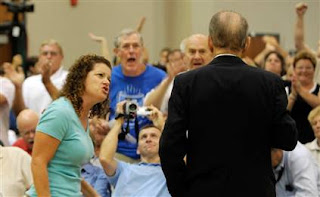
is what Agosto Boal

had in mind when he created the Theatre of the Oppressed.
So, here's my question: How do we reclaim the use of theatre in order to promote progressive, people-centered, positive change in politics, but also in other socially relevant areas? How do we convince those in power to pay attention to those without a voice? What would the world look like if Victor Papanek and Agosto Boal had collaborated on a project? These are all things I will be thinking about today. If you have any ideas, please share them here.

is what Agosto Boal

had in mind when he created the Theatre of the Oppressed.
So, here's my question: How do we reclaim the use of theatre in order to promote progressive, people-centered, positive change in politics, but also in other socially relevant areas? How do we convince those in power to pay attention to those without a voice? What would the world look like if Victor Papanek and Agosto Boal had collaborated on a project? These are all things I will be thinking about today. If you have any ideas, please share them here.
Tuesday, July 14, 2009
Pics of the Recession
I just saw this on the Huffington Post. People were asked to take pictures of the recession. Not surprisingly, there were no pictures that cast the recession in a more hopeful light. Granted, the state of the economy sucks. But at the same time, there are so many opportunities to change things, and nobody seems to be documenting those opportunities. So, I decided to hunt around the interwebs for some pictures/videos. This is what I found:
Urban Rainwater Collection

© 2009 Michael Casey

Recycling

©2009 PinkSherbetPhotograhy
Alternative Transportation (Critical Mass in Atlanta):

Solar Power (GA Power is testing this on their HQ roof!)

Star Island's New Aurora Wind Turbine
Star Island's new Aurora wind turbine
Originally uploaded by Brian W
I am certain that if the economy hadn't tanked, people (and companies like GA Power) wouldn't be making these changes right now. Yes, the environment and "green" technologies are all the rage, but if it weren't for the fact that oil and gas are depleting our wallets as quickly as they are, we (Americans) wouldn't be responding to the environmental call. Star Island is an exception to this statement. However, even for an organization as environmentally conscious as the Star Island Corp, their building code problems and subsequent financial issues pushed them to make changes more quickly than they would have otherwise. Before the financial crisis, any Star Island initiative would have gotten tangled up in committees and sub-committees and taken years to implement.
Forced innovation (and I'm not talking about the massive Shock Doctrine-ish Neo-Liberal kind) can be a good thing.
Monday, July 13, 2009
The Tupperware Party of the '00s
On Saturday, I went to a jewelry party. It's like a tupperware party, but with jewelry manufactured abroad and sold/distributed nationally. Here's the basic concept, as I understand it:

A rep brings catalogs of the schwag, a few pieces of jewelry, and order forms. We sit, listen, play a catalog game, and hopefully (for the rep), buy something.
What's the appeal? That's simple. Money--both making it (the rep) and saving it (the consumer). And that's okay, especially when we're all trying to figure out a way to make ends meet. Imagine you're unsatisfied with your relatively stable, yet underpaid job, but you don't dare quit while the economy is in a state of disrepair, so you try something to supplement your income so that you can pay for decent childcare, or petfood, or a new refrigerator. I can respect that. Identifying a problem and doing something to address it rather than sitting on the couch and sulking is commendable.
Now, I'm wondering if there's a way for a person to take this business model, make some changes, and do something that's both profitable, sustainable, and responsible in his or her spare time rather than funneling money to a corporate structure that may or may not give a damn about the people making their jewelry (clothing, accesories, housewares, whatever) or the environment it affects.
Okay, so back to the business model. Why does it work?
1) Money: The rep gets a percentage of the sales she makes. The host gets a discount on merchandise and can get a percentage of sales she generates independently.
2) Marketing: This company gets a database full of names and addresses every time someone throws a party. This is in addition to the obvious influx of cash.
3) Safety in numbers/familiarity/peer pressure: Friends put their friends' names on the list. Women like myself want to support their friends, so are less likely to refuse a sales pitch or follow-up marketing materials.
4) Tangibility: There's a catalog, so people have something tangible to take with them, and at the parties, people can see and touch some of the actual goods. The tangibility factor is a big one for me, despite the influence of the online world. You can't tell what something's going to look like online. I don't care how good your imagination is, or how high your picture resolution may be.
5) PR: The company donates jewelry in addition to a percentage of the proceeds of the sales of a specific piece to Dress for Success. I suspect that that is more of a tax write-off than it is a genuine desire to help disadvantaged women to dress smartly for job interviews, but maybe I'm just being cynical. I should give them a little bit of credit and say at least they are doing something. But I want more.
What I'd like to know is how could the positive points of this business model be used in a way that could help legitimate local artisans and craftspeople sell their wares (see the pic below of rings that Davidson Alum Julie Failey has designed) while allowing everyone involved to nuture the triple bottom line (i.e. People, Profit, Planet)? Also, if anyone has direct experience being involved with something like this, what do you think the flaws are? How could it be improved?
Would it be a cross between an Amway/Tupperware pyramidish scheme, one of those excluive business networking clubs, and a craft show? What would that look like? Would it include or be exclusively custom designs? Who would the market be? How could it be scalable? How could online media and social networking sites promote this effectively? How could this model help other artistic disciplines (clothing, music, dance, film, fine art, etc.)? Feel free to respond if you have any ideas.
Thursday, July 9, 2009
Start Again
Well, it's been a while. I finished my Master's Degree in December. It's now July. ,
I am in Atlanta, GA waiting for my UK Visa to come through. It's been a ridiculously long string of red tape, and I'm predicting (see also: hoping) that the string will break in the next two weeks. If it weren't for my fantastic family and friends, and my recent trip to Star Island
,I wouldn't be taking this huge roadblock in such a positive light.
And if it weren't for my experience in grad school, I wouldn't be as productive as I am. For instance, I'm working on a project with my old roommate, Jason. My time in Atlanta has allowed us to have a fighting chance at getting this thing off of the ground. If we manage to make it happen, it could be a huge stepping stone towards my goal of becoming an independent innovation consultant who deals with the 4th sector. Even if we don't manage to make it happen, it will be excellent practice for whatever may lie ahead. The skinny is that it has to do with Senegal. That's all I'm saying for now.
Subscribe to:
Posts (Atom)